






Table of Contents (TOC)
- What is Data Analytics?
- Why Data Analytics Matters
- Types of Data Analytics
- Key Components of Data Analytics
- Popular Data Analytics Tools
- Benefits of Data Analytics
- Real-World Examples of Data Analytics
- Challenges in Data Analytics
- Future of Data Analytics
- Conclusion
- Frequently Asked Questions (FAQ)
What is Data Analytics?
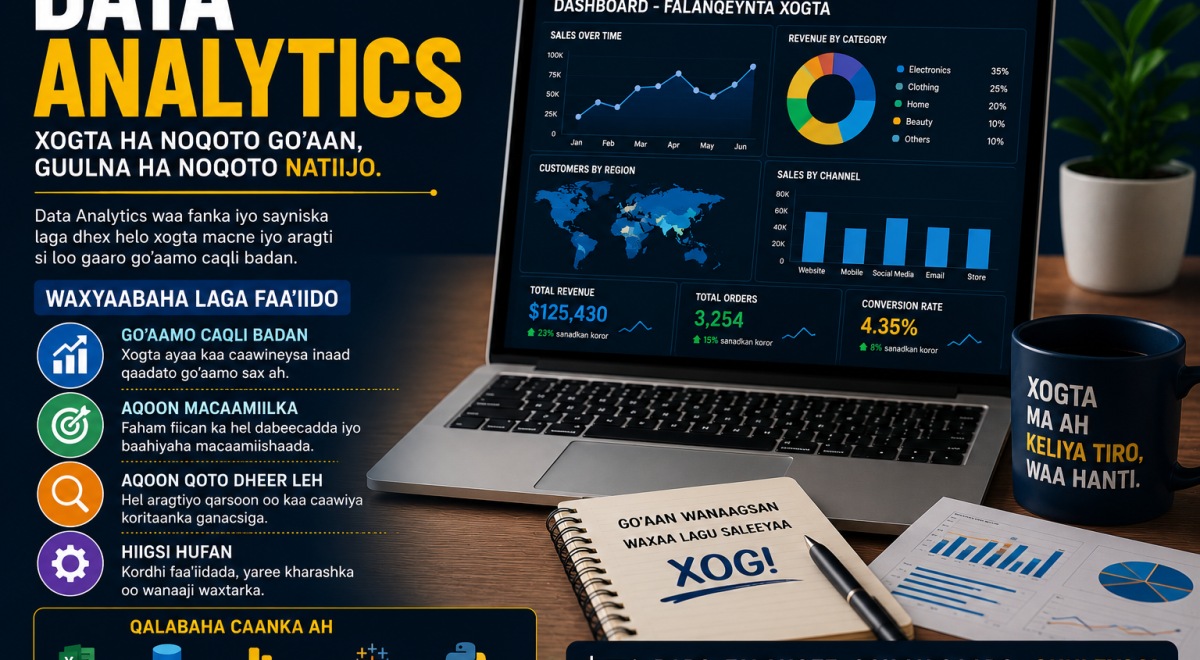
Data Analytics is the process of collecting, organizing, analyzing, and interpreting data to discover useful insights and support decision-making. In today’s digital world, businesses generate massive amounts of data every day. Data analytics helps transform this raw information into meaningful knowledge that organizations can use to improve performance and achieve their goals.
Whether it is customer behavior, website traffic, sales performance, or market trends, data analytics provides valuable information that helps businesses make informed decisions.
Why Data Analytics Matters
Data analytics has become one of the most important business tools in the modern world. Organizations use data-driven insights to understand customers, improve products, reduce costs, and increase profitability.
Some key reasons why data analytics matters include:
- Better decision-making
- Improved customer experience
- Increased operational efficiency
- Competitive advantage
- Risk reduction
- Revenue growth
Companies that effectively use data analytics often outperform competitors because they can identify opportunities and solve problems faster.
Types of Data Analytics
1. Descriptive Analytics
Descriptive analytics focuses on understanding what happened in the past. It summarizes historical data using reports, dashboards, and visualizations.
Example:
A company analyzes last year’s sales data to identify top-performing products.
2. Diagnostic Analytics
Diagnostic analytics explains why something happened by examining relationships between different data points.
Example:
An online store investigates why website traffic dropped during a specific month.
3. Predictive Analytics
Predictive analytics uses historical data, machine learning, and statistical models to forecast future outcomes.
Example:
Netflix recommends movies based on viewing history.
4. Prescriptive Analytics
Prescriptive analytics suggests actions that organizations should take to achieve desired outcomes.
Example:
A logistics company optimizes delivery routes to reduce fuel costs.
Key Components of Data Analytics
Data Collection
The first step involves gathering data from various sources such as:
- Websites
- Social media platforms
- CRM systems
- Mobile applications
- Surveys
- IoT devices
Data Cleaning
Raw data often contains errors, duplicates, and missing values. Data cleaning ensures accuracy and reliability.
Data Processing
After cleaning, data is organized into a structured format suitable for analysis.
Data Analysis
Analysts use statistical techniques and software tools to identify patterns and trends.
Data Visualization
Visualization tools help present findings through:
- Charts
- Graphs
- Dashboards
- Reports
Popular Data Analytics Tools
Several tools are commonly used by data analysts:
Microsoft Power BI
Power BI enables businesses to create interactive dashboards and visual reports.
Tableau
Tableau is known for its powerful data visualization capabilities.
Google Analytics
Google Analytics helps website owners monitor traffic and user behavior.
Python
Python is widely used for data analysis, machine learning, and automation.
SQL
SQL allows analysts to query and manage databases efficiently.
Benefits of Data Analytics
Improved Decision-Making
Organizations can make informed decisions based on facts rather than assumptions.
Better Customer Understanding
Data analytics helps businesses understand customer preferences and behavior.
Increased Efficiency
Companies can identify inefficiencies and optimize processes.
Cost Reduction
Data-driven insights help reduce unnecessary expenses.
Revenue Growth
Organizations can discover new opportunities and improve sales performance.
Real-World Examples of Data Analytics
Amazon
Amazon uses data analytics to recommend products based on customer browsing and purchase history.
Netflix
Netflix analyzes user viewing patterns to provide personalized content recommendations.
Healthcare Industry
Hospitals use data analytics to improve patient care and predict disease outbreaks.
Banking Sector
Banks use analytics to detect fraudulent transactions and manage financial risks.
Facts About Data Analytics
- More than 90% of the world’s data has been generated in recent years.
- Businesses using data-driven strategies are significantly more profitable than competitors.
- Data analytics is among the fastest-growing career fields globally.
- The demand for data analysts continues to increase across industries.
Challenges in Data Analytics
Data Quality Issues
Poor-quality data can lead to inaccurate results.
Data Security
Organizations must protect sensitive information from cyber threats.
Skill Gaps
Finding experienced data analysts remains a challenge.
Data Integration
Combining data from multiple sources can be complex.
Future of Data Analytics
The future of data analytics is being shaped by technologies such as:
Artificial Intelligence
AI enhances analytics by automating complex processes.
Machine Learning
Machine learning models improve prediction accuracy over time.
Big Data
Organizations are leveraging massive datasets to gain deeper insights.
Real-Time Analytics
Businesses increasingly rely on real-time data for faster decision-making.
As technology continues to evolve, data analytics will play an even greater role in business success.
Internal Links
- Data Science Guide
- Business Intelligence Explained
- Machine Learning Basics
- Big Data Technologies
- Digital Marketing Analytics
External Links
- https://analytics.google.com
- https://powerbi.microsoft.com
- https://www.tableau.com
- https://www.python.org
- https://www.ibm.com/analytics
Frequently Asked Questions (FAQ)
What is Data Analytics?
Data Analytics is the process of examining data to discover patterns, trends, and insights that support decision-making.
Why is Data Analytics important?
It helps businesses improve decision-making, increase efficiency, reduce costs, and enhance customer experiences.
What are the four types of Data Analytics?
The four types are:
- Descriptive Analytics
- Diagnostic Analytics
- Predictive Analytics
- Prescriptive Analytics
Which tools are used in Data Analytics?
Popular tools include Power BI, Tableau, Google Analytics, Python, and SQL.
Is Data Analytics a good career?
Yes. Data Analytics is one of the fastest-growing and highest-demand career fields globally.
How does Data Analytics help businesses?
It provides actionable insights that improve operations, customer satisfaction, and profitability.
Conclusion
Data Analytics has become an essential tool for modern organizations seeking growth, efficiency, and competitive advantage. By collecting, analyzing, and interpreting data, businesses can make smarter decisions, understand customers better, and identify new opportunities.
From descriptive analytics to predictive and prescriptive analytics, data-driven strategies are transforming industries worldwide. As technologies such as artificial intelligence and machine learning continue to advance, the importance of data analytics will only increase.
Organizations that invest in data analytics today will be better positioned for long-term success in an increasingly digital world.https://risesom.com/wp-admin/post.php?post=313&action=edit

RiseSom is an online media platform sharing quality content on technology, business, finance, sports, travel, and global trends. We are committed to providing reliable, informative, and reader-friendly articles.