





Table of Contents
- What Is 5G Technology?
- How 5G Technology Works
- Key Features of 5G Technology
- Benefits of 5G Technology
- Real-World Applications
- Challenges and Limitations
- The Future of 5G Technology
- Frequently Asked Questions
- Conclusion
What Is 5G Technology?
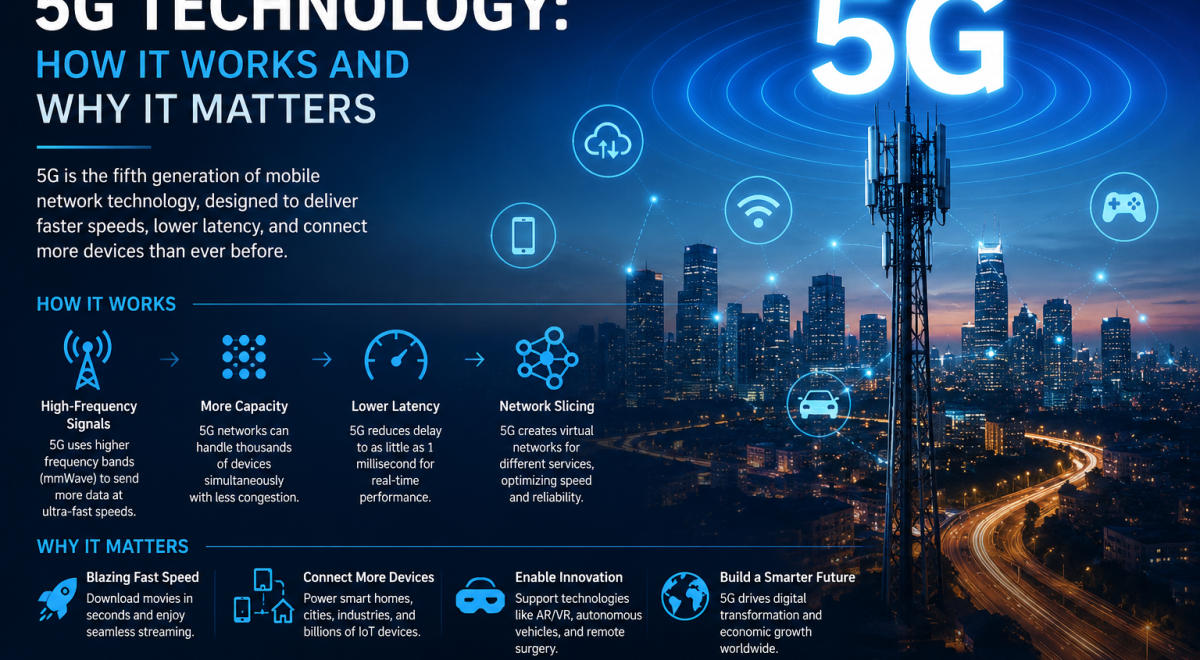
5G Technology is the fifth generation of wireless mobile communication. It is designed to provide significantly faster internet speeds, lower latency, and greater network capacity than previous generations such as 4G LTE. As more people connect smartphones, computers, smart home devices, and industrial equipment to the internet, 5G Technology helps meet the growing demand for reliable and high-speed connectivity.
Unlike earlier mobile networks that focused mainly on faster downloads, 5G Technology supports millions of connected devices simultaneously while maintaining stable performance. This makes it a foundation for innovations such as smart cities, autonomous vehicles, remote healthcare, cloud gaming, and the Internet of Things (IoT).
Today, governments, telecommunications companies, and technology businesses are investing heavily in 5G infrastructure because it is expected to drive economic growth, improve digital services, and create new business opportunities around the world.
Why 5G Technology Matters
Modern life depends on fast and reliable internet access. People use mobile devices for communication, online learning, video streaming, digital banking, business operations, and entertainment every day. As internet usage continues to increase, older mobile networks face challenges in handling large amounts of data efficiently.
5G Technology addresses these challenges by delivering:
- Faster download and upload speeds
- Lower network latency
- Improved reliability
- Higher device capacity
- Better support for smart technologies
These improvements help individuals, businesses, healthcare providers, educational institutions, and governments operate more efficiently.
How 5G Technology Works
Unlike previous wireless generations, 5G Technology combines several advanced technologies to improve speed and network efficiency.
Small Cells
Instead of relying only on large cellular towers, 5G uses many small base stations installed on buildings, streetlights, and utility poles. These small cells reduce network congestion and improve signal quality, especially in busy urban areas.
Massive MIMO
Massive Multiple Input Multiple Output (Massive MIMO) allows network towers to communicate with many devices at the same time using dozens of antennas. This significantly increases network capacity while maintaining strong performance.
Beamforming
Beamforming is an intelligent signal management technology that directs wireless signals toward a specific device rather than broadcasting equally in every direction. This results in stronger connections, faster speeds, and reduced interference.
Millimeter Wave Spectrum
Some 5G networks use high-frequency millimeter wave bands that can transmit enormous amounts of data at extremely high speeds. Although these signals travel shorter distances and can be blocked by buildings or trees, they provide exceptional performance in densely populated locations.
Key Features of 5G Technology
Ultra-Fast Speed
One of the biggest advantages of 5G Technology is its exceptional speed. Under ideal conditions, download speeds can reach several gigabits per second, making it possible to download large files, stream ultra-high-definition videos, and enjoy smooth cloud gaming experiences.
Low Latency
Latency refers to the time required for data to travel between devices. 5G Technology dramatically reduces latency, enabling near real-time communication. This is especially important for autonomous vehicles, industrial automation, online gaming, and remote medical procedures.
Increased Network Capacity
Modern cities contain millions of connected devices. 5G networks are designed to support this growing demand without sacrificing performance, making them ideal for smart cities and Internet of Things (IoT) applications.
Greater Reliability
Businesses and public services require stable internet connections. 5G Technology improves network reliability by reducing congestion and maintaining consistent performance, even during periods of heavy usage.
Benefits of 5G Technology
The introduction of 5G Technology is transforming the way people communicate, work, and access digital services. Its improvements in speed, capacity, and reliability provide significant benefits across multiple sectors.
Faster Internet Experience
One of the most noticeable advantages of 5G Technology is faster internet connectivity. Users can download large files within seconds, stream 4K and 8K videos without buffering, and enjoy smoother online experiences.
For example, a high-definition movie that may take several minutes to download on a 4G network can often be downloaded much faster on a 5G network.
Improved Remote Work and Collaboration
Remote work has become an essential part of modern business operations. 5G Technology supports high-quality video conferencing, cloud-based applications, and real-time collaboration tools with minimal delays.
Businesses can improve productivity by enabling employees to access company resources quickly from virtually any location.
Better Online Education
Educational institutions increasingly rely on digital learning platforms. With 5G Technology, students can participate in live virtual classes, access educational content instantly, and collaborate with teachers and classmates more effectively.
Reliable connectivity helps reduce interruptions during online learning sessions and improves the overall educational experience.
Enhanced Healthcare Services
Healthcare is one of the industries expected to benefit significantly from 5G Technology.
Medical professionals can:
- Conduct remote consultations
- Monitor patients using connected devices
- Transfer medical images quickly
- Support advanced telemedicine solutions
In the future, low-latency communication may also assist with certain remote medical procedures that require immediate responsiveness.
Economic Growth and Innovation
Many experts believe that 5G Technology will contribute substantially to economic growth by creating new business opportunities and supporting innovation.
Industries such as manufacturing, transportation, logistics, agriculture, and retail can use 5G-powered solutions to improve efficiency and reduce operational costs.
Real-World Applications of 5G Technology
The impact of 5G Technology extends far beyond faster smartphones. It is enabling new technologies that were previously difficult or impossible to implement effectively.
Smart Cities
Smart cities use connected sensors and devices to improve public services and infrastructure management.
Examples include:
- Intelligent traffic systems
- Smart street lighting
- Waste management monitoring
- Public safety systems
- Energy-efficient infrastructure
With 5G Technology, these systems can communicate more efficiently and process information in real time.
Example
A smart traffic management system can analyze vehicle movement and automatically adjust traffic signals to reduce congestion and improve road safety.
Internet of Things (IoT)
The Internet of Things refers to everyday devices connected to the internet.
Examples include:
- Smart home devices
- Security cameras
- Smart thermostats
- Industrial sensors
- Agricultural monitoring equipment
Because 5G Technology supports a large number of connected devices simultaneously, it serves as a critical foundation for IoT expansion.
Example
Farmers can use connected sensors to monitor soil conditions, weather patterns, and irrigation systems, helping increase agricultural productivity.
Autonomous Vehicles
Self-driving vehicles depend on rapid communication between vehicles, sensors, and transportation infrastructure.
The low latency offered by 5G Technology enables faster data exchange, improving decision-making and road safety.
Example
An autonomous vehicle can instantly receive traffic information, road hazard alerts, and navigation updates to react more effectively to changing conditions.
Industrial Automation
Manufacturing facilities increasingly use robotics, sensors, and automated systems.
5G Technology allows factories to:
- Monitor equipment performance
- Improve production efficiency
- Reduce downtime
- Enhance workplace safety
This concept is often referred to as Industry 4.0.
Example
A factory can use connected sensors to detect machine issues before a breakdown occurs, reducing maintenance costs and preventing production delays.
Entertainment and Gaming
The entertainment industry is also benefiting from 5G Technology.
Users can enjoy:
- High-definition streaming
- Virtual reality experiences
- Augmented reality applications
- Cloud gaming services
Low latency and fast speeds improve user experiences and reduce interruptions.
Example
Cloud gaming platforms allow players to stream games directly from remote servers without requiring expensive gaming hardware.
Facts About 5G Technology
Here are several important facts about 5G Technology:
Fact 1
5G is designed to be significantly faster than previous mobile network generations.
Fact 2
5G networks can support many more connected devices per square kilometer than 4G networks.
Fact 3
Low latency makes 5G suitable for real-time applications such as autonomous vehicles and industrial automation.
Fact 4
5G Technology supports emerging technologies including artificial intelligence, smart cities, and the Internet of Things.
Fact 5
Global investment in 5G infrastructure continues to grow as countries seek to strengthen digital economies and improve connectivity.
Challenges and Limitations of 5G Technology
Despite its advantages, 5G Technology also faces several challenges.
Infrastructure Costs
Building 5G networks requires significant investment in equipment, towers, small cells, and maintenance.
Telecommunications providers must spend substantial resources to expand coverage areas.
Coverage Limitations
Some high-frequency 5G signals do not travel as far as lower-frequency signals and may be affected by physical obstacles such as buildings and trees.
As a result, network providers often need additional infrastructure to ensure consistent coverage.
Device Compatibility
Users need compatible smartphones and devices to access full 5G capabilities. Older devices may not support the latest network standards.
Security Considerations
As more devices become connected, cybersecurity remains an important priority. Organizations must continue implementing strong security measures to protect sensitive data and digital systems.data and digital systems.
The Future of 5G Technology
The future of 5G Technology looks promising as network coverage continues to expand across the world. Businesses, governments, and technology companies are investing in next-generation infrastructure to support digital transformation and innovation.
Over the coming years, 5G is expected to power advanced artificial intelligence (AI), smart transportation systems, connected healthcare, industrial automation, and immersive technologies such as augmented reality (AR) and virtual reality (VR). As more devices become internet-connected, the demand for reliable, high-speed communication will continue to grow.
Researchers are also working on future wireless technologies that will build upon the success of 5G, ensuring even faster communication and greater efficiency in the years ahead.
Conclusion
5G Technology is much more than an upgrade from previous mobile networks. It represents a major step forward in wireless communication by delivering faster speeds, lower latency, higher capacity, and improved reliability.
From healthcare and education to manufacturing, transportation, and entertainment, 5G is enabling innovations that improve productivity and create new opportunities for businesses and individuals alike.
Although challenges such as infrastructure costs, device compatibility, and network expansion remain, the long-term benefits of 5G Technology are expected to outweigh these obstacles. As adoption increases worldwide, 5G will continue shaping the future of digital communication and connected technologies.
Whether you are a student, business owner, technology enthusiast, or everyday smartphone user, understanding 5G Technology helps you prepare for a more connected and intelligent digital future.
Frequently Asked Questions (FAQ)
1. What is 5G Technology?
5G Technology is the fifth generation of wireless mobile communication that provides faster internet speeds, lower latency, and greater network capacity than previous generations.
2. Is 5G faster than 4G?
Yes. Under suitable conditions, 5G Technology offers much higher download and upload speeds than 4G, making activities such as streaming, gaming, and video conferencing smoother.
3. What are the main benefits of 5G Technology?
The major benefits include:
- Faster internet speeds
- Lower latency
- Better network reliability
- Support for more connected devices
- Improved smart technologies and IoT applications
4. Where is 5G Technology used?
5G is used in:
- Smartphones
- Smart cities
- Healthcare
- Manufacturing
- Education
- Transportation
- Agriculture
- Cloud computing
- Internet of Things (IoT)
5. Does 5G Technology require a new phone?
Yes. To enjoy full 5G connectivity, users generally need a smartphone or device that supports 5G networks.
Internal Links (Replace with your website URLs)
- Home → https://risesom.com/
- Technology Category → https://risesom.com/category/technology/
- Artificial Intelligence Guide → https://risesom.com/artificial-intelligence-guide/
- Cloud Computing Explained → https://risesom.com/cloud-computing-explained/
- Cybersecurity Tips → https://risesom.com/cybersecurity-tips/
External Links
- GSMA – https://www.gsma.com/
- 3GPP – https://www.3gpp.org/
- International Telecommunication Union (ITU) – https://www.itu.int/
- Qualcomm – https://www.qualcomm.com/
- Ericsson – https://www.ericsson.com/

RiseSom is an online media platform sharing quality content on technology, business, finance, sports, travel, and global trends. We are committed to providing reliable, informative, and reader-friendly articles.