


Table of Contents
- Introduction
- The Rise of Next-Generation Artificial Intelligence
- Quantum Computing: Moving from Lab to Market
- Biotechnology and Genetic Engineering Breakthroughs
- Green Tech and Sustainable Energy Innovations
- The Evolution of Cyber-Physical Security
- Frequently Asked Questions (FAQ)
- Conclusion
Introduction
The technological landscape is moving at an unprecedented pace. As we navigate through 2026, researchers and scientists are pushing the boundaries of what is possible, merging the digital world with physical and biological realities. Keeping up with these changes is no longer just an advantage—it is a necessity for businesses, developers, and policymakers alike.
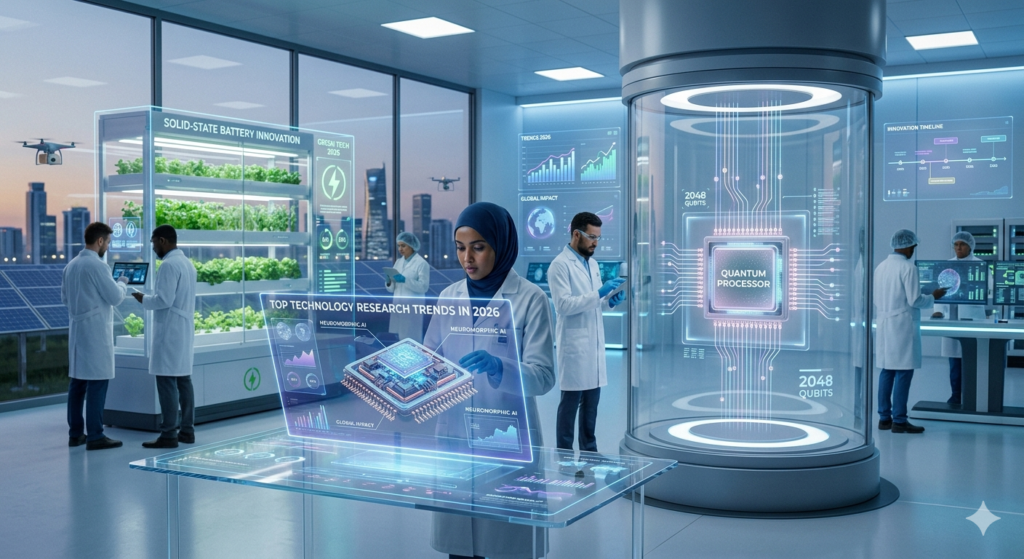
Understanding the top technology research trends in 2026 gives us a clear roadmap of how industries will transform over the next decade. From advanced computational systems to groundbreaking clean energy solutions, these innovations are actively shaping the future of humanity.
The Rise of Next-Generation Artificial Intelligence
Artificial Intelligence (AI) has transitioned from basic automation to highly sophisticated, autonomous systems. In 2026, the research focus has shifted toward creating AI that is more contextual, energy-efficient, and capable of multi-modal reasoning.
Agentic AI and Autonomous Workforces
Instead of merely responding to prompts, AI systems in 2026 act as autonomous agents. They can plan complex workflows, make real-time decisions, and collaborate with other AI systems to solve intricate business problems.
Neuromorphic Computing for AI
Traditional data centers consume massive amounts of electricity. To combat this, researchers are heavily investing in neuromorphic hardware—chips designed to mimic the human brain’s neural structure. This drastically reduces energy consumption while boosting processing speeds.
Fact: Recent studies show that neuromorphic chips can process complex AI algorithms using up to 80% less power than traditional silicon processors.
Quantum Computing: Moving from Lab to Market
For years, quantum computing was a theoretical concept confined to high-tech research laboratories. However, one of the most exciting top technology research trends in 2026 is the commercial stabilization of quantum systems.
[Classical Computers] ---> Process data in bits (0 or 1) Linearly
[Quantum Computers]   ---> Process data in qubits (0 and 1 simultaneously) Exponentially
Quantum Cryptography and Security
As quantum computers become more powerful, they pose a threat to standard encryption methods. Therefore, researchers have prioritized Post-Quantum Cryptography (PQC). Organizations are racing to implement quantum-resistant algorithms to safeguard sensitive financial and national security data.
Material Science Innovations
By simulating molecular structures at a quantum level, scientists are discovering new materials in days rather than decades. This has accelerated the development of superconducting materials and high-efficiency batteries. Learn more about the global standards for quantum development on the IEEE Advanced Technology Platform.
Biotechnology and Genetic Engineering Breakthroughs
The intersection of technology and biology is producing some of the most profound innovations of our time. Healthcare is rapidly moving away from one-size-fits-all treatments toward highly precise, digitized medicine.
CRISPR 2.0 and Epigenetic Editing
While the original CRISPR technology allowed for cutting and pasting DNA, 2026 research focuses on epigenetic editing. This allows scientists to turn specific genes on or off without altering the underlying DNA sequence permanently, reducing the risk of unintended genetic mutations.
Bioprinting Functional Organs
3D bioprinting has advanced to the point where researchers can successfully print vascularized tissue structures.
- Customized Implants: Creating bone and cartilage replacements tailored to a patient’s exact anatomy.
- Drug Testing: Using printed human tissue to test new medications, completely eliminating the need for animal testing.
Green Tech and Sustainable Energy Innovations
Climate change demands radical technological solutions. The top technology research trends in 2026 highlight a massive surge in clean energy research aimed at achieving net-zero carbon emissions.
Solid-State Batteries
The electric vehicle (EV) market is undergoing a revolution due to solid-state battery technology. Unlike liquid lithium-ion batteries, solid-state variants use solid electrolytes, making them safer, faster to charge, and capable of holding twice the energy density.
Hydrogen and Fusion Energy Milestones
Nuclear fusion research has seen groundbreaking milestones this year, with magnetic confinement reactors sustaining net-energy gains for longer durations than ever before. Simultaneously, green hydrogen production has become commercially viable, providing a clean fuel alternative for heavy industries like shipping and steel manufacturing.
The Evolution of Cyber-Physical Security
As our physical world becomes more deeply integrated with digital networks—through smart cities, autonomous vehicles, and connected medical devices—the attack surface for cyber threats has expanded exponentially.
Zero-Trust Architecture for IoT
In 2026, the concept of “never trust, always verify” is being hardcoded into the hardware level of Internet of Things (IoT) devices. This ensures that even if one device in a network is compromised, the breach cannot spread to the rest of the infrastructure.
AI-Driven Threat Hunting
Standard firewalls are no longer sufficient. Modern cybersecurity research focuses on predictive AI models that can detect subtle anomalies in network behavior, neutralizing cyber threats before they even manifest. For more insights on safeguarding enterprise networks, check out our comprehensive guide on Advanced Cybersecurity Strategies for Modern Enterprise Ecosystems.
Frequently Asked Questions (FAQ)
What are the top technology research trends in 2026?
The leading trends include Agentic Artificial Intelligence, commercial quantum computing applications, advanced CRISPR gene editing, solid-state batteries, and next-generation cyber-physical security frameworks.
Why is quantum computing important in 2026?
Quantum computing allows for exponential data processing capabilities. In 2026, it is actively transforming material science, financial modeling, and drug discovery by solving problems that would take classical computers thousands of years to compute.
How is AI evolving this year?
AI is transitioning from a reactive tool to an autonomous collaborator (Agentic AI). Research is heavily focused on making AI systems energy-efficient through neuromorphic computing and multi-modal understanding.
Conclusion
The top technology research trends in 2026 clearly demonstrate that the future belongs to interconnected, intelligent, and sustainable innovations. As AI becomes more autonomous, quantum computing stabilizes, and green technology matures, the boundaries between different scientific disciplines are dissolving.
Embracing these innovations today will define the economic and social leaders of tomorrow. Staying informed and adaptable is the best way to thrive in this rapidly shaping future.


RiseSom is an online media platform sharing quality content on technology, business, finance, sports, travel, and global trends. We are committed to providing reliable, informative, and reader-friendly articles.