


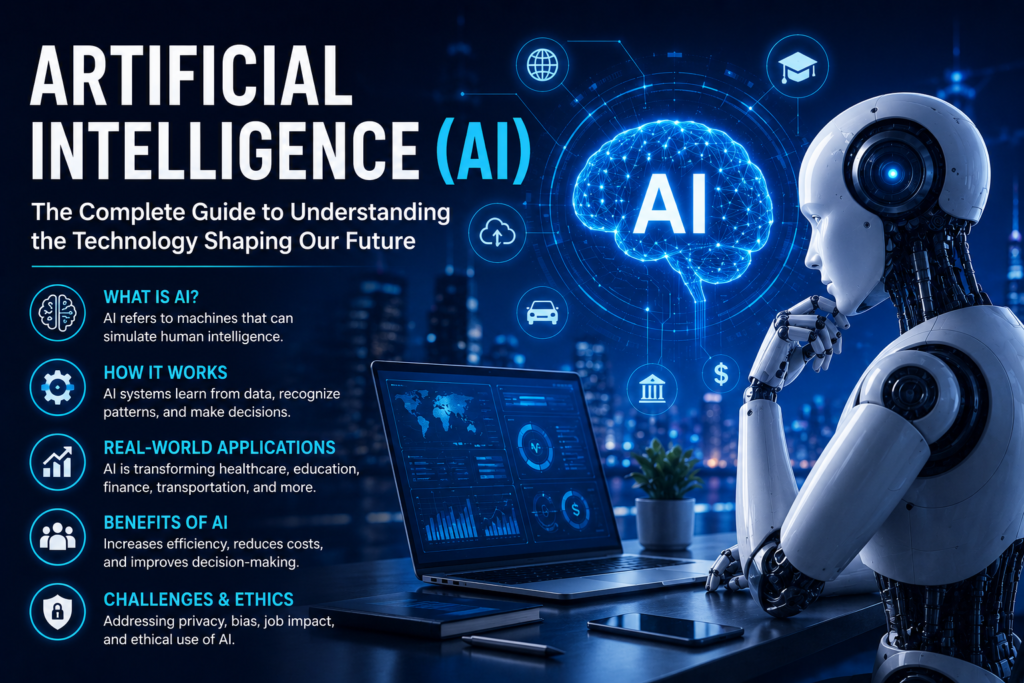
Artificial Intelligence (AI): The Complete Guide to Understanding the Technology Shaping Our Future
Introduction
Artificial Intelligence (AI) is one of the most revolutionary technologies of the 21st century. It is transforming industries, improving efficiency, and changing the way people interact with technology. From virtual assistants and recommendation systems to self-driving cars and advanced medical diagnostics, Artificial Intelligence is becoming a part of everyday life.
In this comprehensive guide, we will explore what Artificial Intelligence is, how it works, its benefits, challenges, real-world applications, and its future impact on society.
What Is Artificial Intelligence (AI)?
Artificial Intelligence (AI) refers to the ability of computer systems to perform tasks that normally require human intelligence.
These tasks include:
- Learning from data
- Solving problems
- Recognizing speech
- Understanding language
- Making decisions
- Identifying patterns
Simply put, AI enables machines to think, learn, and adapt similarly to humans.
Why Artificial Intelligence Matters
Artificial Intelligence is changing how businesses operate and how individuals use technology.
Key Benefits of AI
- Increased productivity
- Faster decision-making
- Reduced operational costs
- Improved customer experiences
- Better data analysis
Fact
Many businesses now use AI-powered systems to automate routine tasks and improve efficiency.
How Artificial Intelligence Works
AI systems rely on data, algorithms, and computing power.
The Basic Process
1. Data Collection
AI learns from large amounts of data.
Examples include:
- Images
- Videos
- Text documents
- Customer information
- Sensor readings
2. Training
Algorithms analyze data and identify patterns.
3. Learning
The system improves its performance through experience.
4. Decision Making
AI uses learned information to make predictions or recommendations.
Types of Artificial Intelligence
Artificial Intelligence can be divided into different categories.
Narrow AI
Also called Weak AI.
Designed for specific tasks.
Examples
- Virtual assistants
- Recommendation systems
- Spam filters
- Navigation apps
Most AI systems today belong to this category.
General AI
General AI would perform intellectual tasks at a human level.
Characteristics
- Human-like reasoning
- Problem-solving abilities
- Adaptability
General AI remains largely theoretical.
Super AI
A hypothetical future AI that surpasses human intelligence.
Potential Capabilities
- Advanced creativity
- Scientific breakthroughs
- Complex decision-making
Researchers continue debating its possibilities and risks.
Major Technologies Behind AI
Several technologies make Artificial Intelligence possible.
Machine Learning
Machine Learning allows systems to learn from data without being explicitly programmed.
Applications
- Fraud detection
- Product recommendations
- Sales forecasting
Example
Streaming platforms recommend movies based on viewing history.
Deep Learning
Deep Learning uses neural networks inspired by the human brain.
Uses
- Image recognition
- Voice assistants
- Language translation
Example
Facial recognition systems rely heavily on deep learning technology.
Natural Language Processing (NLP)
NLP helps computers understand human language.
Applications
- Chatbots
- Translation tools
- Content analysis
- Voice assistants
Example
AI chat systems can answer questions and generate content.
Computer Vision
Computer Vision allows machines to interpret images and videos.
Examples
- Security monitoring
- Medical imaging
- Autonomous vehicles
Benefit
Improves accuracy and efficiency in visual analysis.
Real-World Applications of Artificial Intelligence
AI is already transforming multiple industries.
AI in Healthcare
Healthcare is one of the biggest beneficiaries of AI technology.
Applications
- Disease diagnosis
- Drug discovery
- Medical imaging
- Personalized treatment
Example
AI systems help doctors identify diseases faster and more accurately.
Benefits
- Improved patient care
- Reduced costs
- Faster diagnoses
AI in Education
Artificial Intelligence is revolutionizing learning experiences.
Examples
- Personalized learning platforms
- Automated grading
- Virtual tutors
- Student performance analysis
Impact
Students receive customized educational experiences.
AI in Finance
Banks and financial institutions increasingly rely on AI.
Applications
- Fraud detection
- Risk assessment
- Customer support
- Investment analysis
Example
AI can identify suspicious transactions in real time.
AI in Retail
Retail businesses use AI to improve customer experiences.
Uses
- Product recommendations
- Inventory management
- Customer service chatbots
- Sales forecasting
Example
Online stores suggest products based on browsing behavior.
AI in Transportation
Transportation is rapidly evolving due to Artificial Intelligence.
Applications
- Self-driving vehicles
- Traffic management
- Route optimization
- Predictive maintenance
Benefits
- Reduced accidents
- Improved efficiency
- Lower costs
AI in Manufacturing
Factories use AI-powered automation to increase productivity.
Advantages
- Quality control
- Predictive maintenance
- Reduced waste
- Faster production
Example
Smart robots perform repetitive tasks with precision.
Benefits of Artificial Intelligence
Artificial Intelligence offers numerous advantages.
Increased Efficiency
AI performs repetitive tasks quickly and accurately.
Better Decision-Making
AI analyzes massive datasets to generate insights.
Cost Savings
Automation reduces labor-intensive processes.
Enhanced Customer Service
Chatbots provide 24/7 support.
Improved Accuracy
AI systems can reduce human errors in many applications.
Challenges of Artificial Intelligence
Despite its advantages, AI also presents challenges.
Privacy Concerns
AI systems often require large amounts of data.
Risks
- Data misuse
- Unauthorized access
- Privacy violations
Job Displacement
Automation may replace certain repetitive jobs.
Examples
- Data entry
- Basic customer support
- Routine manufacturing tasks
However, AI also creates new employment opportunities.
Ethical Issues
Important questions include:
- Algorithm bias
- Transparency
- Accountability
- Fairness
Organizations must develop responsible AI policies.
Cybersecurity Risks
AI systems can become targets of cyberattacks.
Solution
Implement strong cybersecurity measures and regular monitoring.
Future of Artificial Intelligence
The future of Artificial Intelligence looks extremely promising.
Smarter Virtual Assistants
Future assistants will better understand human behavior and context.
Advanced Healthcare Solutions
AI may help detect diseases earlier and improve treatment outcomes.
Autonomous Transportation
Self-driving technology is expected to become more reliable and widespread.
AI-Powered Businesses
Organizations will increasingly automate operations and improve decision-making through AI.
Scientific Discoveries
Researchers expect AI to accelerate breakthroughs in science and medicine.
How Businesses Can Benefit from AI
Companies that adopt Artificial Intelligence gain competitive advantages.
Key Benefits
- Increased productivity
- Better customer engagement
- Improved forecasting
- Enhanced operational efficiency
- Faster innovation
Example
Many organizations use AI to analyze customer behavior and improve marketing strategies.
Best Practices for Using AI
To maximize success:
Invest in Quality Data
Accurate data improves AI performance.
Focus on Security
Protect sensitive information from cyber threats.
Train Employees
Staff should understand AI tools and their applications.
Use AI Responsibly
Ensure transparency and ethical decision-making.
Internal Links
You may also enjoy reading:
- The Future of Technology: 10 Breakthrough Innovations Shaping Tomorrow
- Cybersecurity Trends in 2026: How to Protect Your Data Online
- Top Technology Trends in 2026
- Best Emerging Technologies to Watch This Year
- Smart Devices and the Internet of Things (IoT)
Conclusion
Artificial Intelligence (AI) is transforming the world at an unprecedented pace. From healthcare and education to finance and transportation, AI is improving efficiency, accuracy, and innovation across industries. While challenges such as privacy concerns and ethical considerations remain, the benefits of Artificial Intelligence continue to drive global adoption.
As technology evolves, AI will play an even greater role in shaping the future. Businesses, governments, and individuals who understand and embrace Artificial Intelligence today will be better positioned to succeed in tomorrow’s digital economy.
The future of Artificial Intelligence is not just about machines becoming smarter—it’s about creating new opportunities, solving complex problems, and improving lives around the world.