


Table of Contents
- Introduction
- What Is Artificial Intelligence?
- Understanding Human Jobs
- AI vs Human Jobs: Key Differences
- Jobs Most Likely to Be Replaced by AI
- Jobs That AI Cannot Easily Replace
- Benefits of AI in the Workplace
- Challenges and Concerns
- The Future of AI and Human Employment
- Examples of AI in Real Industries
- Frequently Asked Questions
- Conclusion
Introduction
The debate surrounding AI vs Human Jobs has become increasingly important as artificial intelligence continues to evolve. Businesses across industries are adopting AI-powered tools to automate tasks, improve efficiency, and reduce operational costs. While many people welcome these technological advancements, others worry about the future of employment.
Will AI replace human workers entirely? Or will it simply transform the way people work?
The reality is more complex than many headlines suggest. Artificial intelligence is changing the workplace, but humans still possess unique skills that machines cannot easily replicate. Understanding the relationship between AI and human jobs is essential for workers, businesses, and policymakers preparing for the future.
What Is Artificial Intelligence?
Artificial Intelligence (AI) refers to computer systems designed to perform tasks that normally require human intelligence. These tasks include learning, problem-solving, decision-making, language understanding, and pattern recognition.
Modern AI technologies include:
- Machine Learning
- Natural Language Processing (NLP)
- Computer Vision
- Predictive Analytics
- Generative AI
AI systems analyze large amounts of data and perform repetitive tasks with speed and accuracy.
Understanding Human Jobs
Human jobs involve tasks that require physical effort, creativity, communication, emotional intelligence, and critical thinking. Throughout history, technological innovations have transformed jobs, but humans have adapted by developing new skills and creating new industries.
Human workers contribute:
- Creativity and innovation
- Emotional understanding
- Leadership abilities
- Ethical decision-making
- Complex problem-solving
These strengths continue to make humans valuable in the modern workforce.
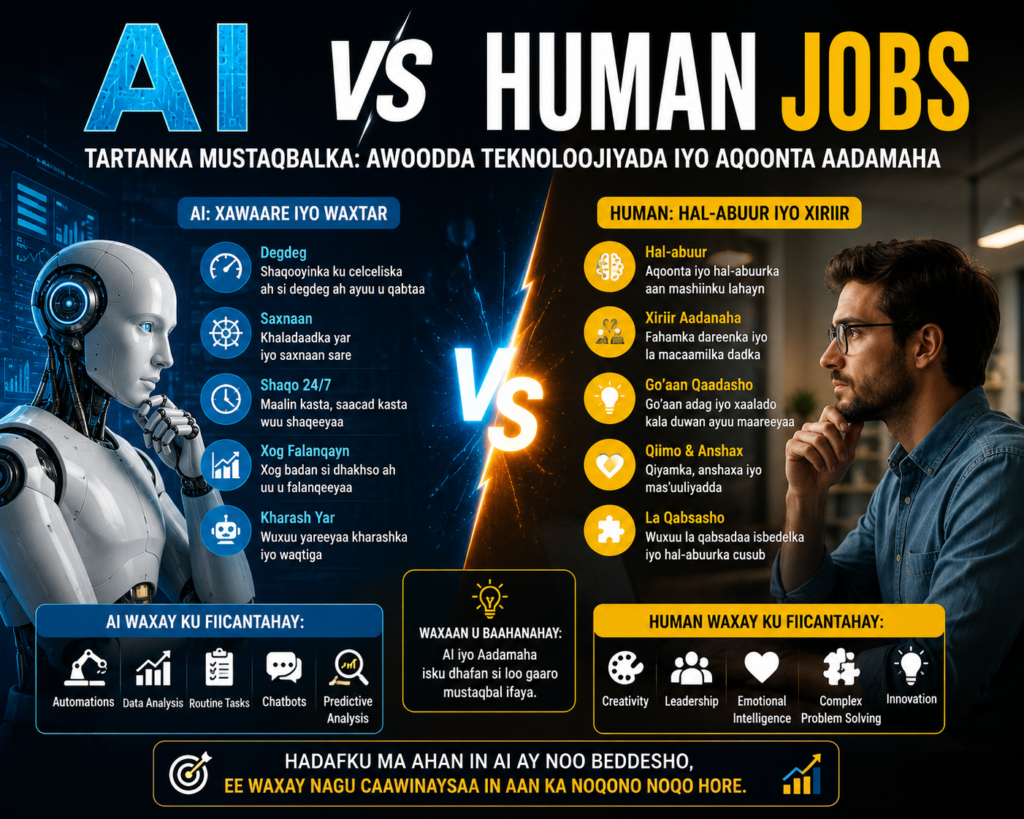
AI vs Human Jobs: Key Differences
Understanding the differences between AI and human workers helps explain why both are likely to coexist.
Speed and Efficiency
AI can process vast amounts of information within seconds. It performs repetitive tasks much faster than humans.
Example
An AI system can analyze thousands of customer records in minutes, while a human employee may need several days.
Creativity
Humans excel at generating original ideas and creative solutions.
Example
Writers, designers, artists, and marketers often rely on imagination and emotional understanding that AI struggles to replicate fully.
Emotional Intelligence
Humans understand emotions, empathy, and social interactions better than machines.
Example
Therapists, teachers, social workers, and healthcare professionals depend heavily on emotional connections.
Adaptability
Humans can quickly adapt to unexpected situations and changing environments.
AI systems often perform best when operating within predefined parameters.
Jobs Most Likely to Be Replaced by AI
Certain occupations involve repetitive and predictable tasks that are easier to automate.
Data Entry Clerks
AI can process and organize data faster and with fewer errors.
Customer Support Agents
Chatbots and virtual assistants now handle many routine customer inquiries.
Manufacturing Workers
Robotic systems can perform assembly-line tasks with high precision.
Cashiers
Self-checkout systems and automated payment technologies reduce the need for manual cash handling.
Basic Bookkeeping
AI accounting software can automate many financial recording processes.
Jobs That AI Cannot Easily Replace
Despite rapid advancements, many careers require uniquely human capabilities.
Healthcare Professionals
Doctors and nurses provide empathy, judgment, and personalized care.
Teachers and Educators
Education involves mentorship, motivation, and human interaction.
Creative Professionals
Writers, filmmakers, musicians, and designers depend on originality and emotional expression.
Business Leaders
Leadership requires strategic thinking, negotiation, and relationship building.
Skilled Trades
Electricians, plumbers, and technicians often face unpredictable situations that require hands-on expertise.
Benefits of AI in the Workplace
AI offers several advantages for businesses and employees.
Increased Productivity
AI automates repetitive tasks, allowing workers to focus on higher-value activities.
Improved Accuracy
Machines reduce human errors in data-intensive processes.
Cost Efficiency
Businesses can lower operational expenses through automation.
Better Decision-Making
AI provides insights based on large datasets that support informed business decisions.
24/7 Operations
Unlike humans, AI systems can operate continuously without breaks.
Challenges and Concerns
The growth of AI also creates significant concerns.
Job Displacement
Some workers may lose jobs due to automation.
Skills Gap
Employees need new skills to remain competitive in an AI-driven economy.
Privacy Issues
AI systems often collect and process large amounts of personal data.
Ethical Questions
Organizations must address fairness, transparency, and accountability when using AI.
Dependence on Technology
Excessive reliance on AI may reduce human oversight and decision-making.
The Future of AI and Human Employment
The future is unlikely to be a simple battle between AI and human workers. Instead, experts predict increased collaboration between humans and intelligent machines.
Many jobs will evolve rather than disappear.
Future workplace trends include:
Human-AI Collaboration
Employees will work alongside AI systems to improve productivity.
New Career Opportunities
Emerging technologies will create entirely new professions.
Continuous Learning
Workers will need ongoing education and skill development.
Increased Demand for Human Skills
Creativity, communication, leadership, and emotional intelligence will become even more valuable.
Examples of AI in Real Industries
Healthcare
AI assists doctors in diagnosing diseases and analyzing medical images.
Banking
Financial institutions use AI to detect fraud and assess risks.
Retail
Retail companies use AI for inventory management and customer recommendations.
Transportation
Self-driving technology and intelligent logistics systems improve efficiency.
Education
AI-powered learning platforms personalize educational experiences for students.
Facts About AI vs Human Jobs
- Millions of businesses worldwide already use AI technologies.
- AI can automate repetitive administrative tasks.
- New technology historically creates new jobs while transforming existing ones.
- Human creativity remains difficult for AI to fully replicate.
- Many future careers will require collaboration between humans and intelligent systems.
Internal Links
- Artificial Intelligence Guide
- Machine Learning Explained
- Future of Technology
- Digital Transformation
- Automation in Business
External Links
- https://www.ibm.com/artificial-intelligence
- https://www.weforum.org
- https://www.mckinsey.com
- https://www.oecd.org
- https://www.microsoft.com/ai
Frequently Asked Questions (FAQ)
Will AI replace all human jobs?
No. While AI can automate certain tasks, many jobs require creativity, emotional intelligence, and complex decision-making that humans provide.
Which jobs are most at risk from AI?
Jobs involving repetitive and predictable tasks, such as data entry, routine customer service, and basic administrative work, face the highest automation risk.
Can AI create new jobs?
Yes. AI is expected to create new career opportunities in technology, data science, AI management, cybersecurity, and many other fields.
What skills will be important in the AI era?
Critical thinking, creativity, communication, leadership, adaptability, and emotional intelligence will remain highly valuable.
Is AI good or bad for employment?
AI presents both opportunities and challenges. While some jobs may disappear, new roles and industries are likely to emerge.
Conclusion
The discussion about AI vs Human Jobs is not simply about replacement—it is about transformation. Artificial intelligence is reshaping industries by automating repetitive tasks, increasing productivity, and supporting data-driven decisions. However, human strengths such as creativity, empathy, leadership, and critical thinking remain irreplaceable.
Rather than viewing AI as a competitor, workers and businesses should see it as a powerful tool that can enhance human capabilities. The future workforce will likely be defined by collaboration between people and intelligent machines. Those who embrace continuous learning and develop uniquely human skills will be best positioned for success in the AI-powered economy.
As technology continues to advance, the most successful organizations will be those that combine the efficiency of AI with the creativity and adaptability of human talent.https://risesom.com/wp-admin/post.php?post=319&action=edit


RiseSom is an online media platform sharing quality content on technology, business, finance, sports, travel, and global trends. We are committed to providing reliable, informative, and reader-friendly articles.